Feb 2019: Otters

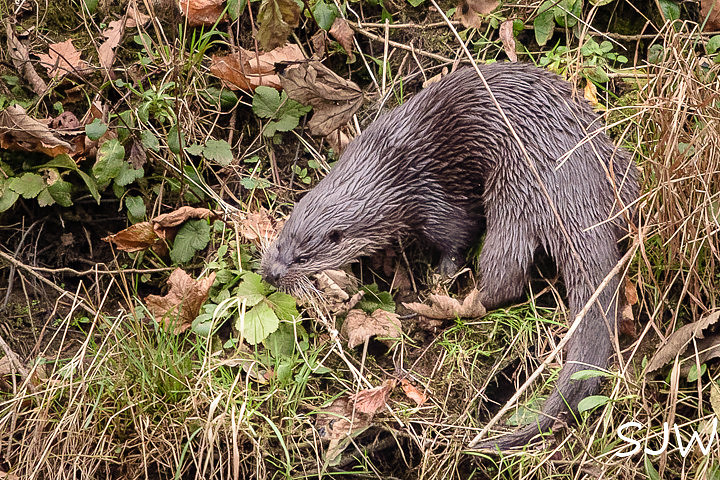

In the 1970s otters (Lutra lutra) had disappeared from most of the waterways of England and Wales. It had been legal to hunt otters with dogs for centuries. However, it seems that environmental pollution was the primary reason for what had been a relatively rapid decline in numbers. In particular this was attributed to the use of organochlorine pesticides in farming and possibly polychlorinated biphenyls (PCBs) in manufacturing. Fortunately, otter hunting was banned in 1976 and, with changes to farming and manufacturing methods, better care of the waterways, and some limited reintroductions, otter numbers are now much improved.
Otters are territorial. A male (dog) otter will aggressively defend several miles of waterway against male incomers. Of course, territories vary in length, but they can extend to 25 miles or more. Consequently, otters have a travelling lifestyle, moving between a number of holts (dens) and resting places. This territoriality means that population density is self-limiting and will never be great. So, with relatively low density and a tendency to be most active at night, otters are not going to be a common sight. However, from time to time, it is possible to see them in the river Wharfe.
During the last month I’ve watched a female otter make repeated trips to collect vegetation from the river bank (see photograph) and then take it, in her mouth, along the river and down into a holt, amongst tree roots. Otters use nesting material to make a comfortable environment for a coming litter of cubs (sometimes referred to as ‘kits’). It seemed this behaviour – gathering vegetation - was an almost daily routine. But after a few days it rained, the river level rose quite sharply, as it does, and since then I’ve only had one fleeting glimpse of her, swimming purposefully down the river. It may be that no more vegetation was needed. But I wonder if the holt became waterlogged and so she has relocated – as they sometimes do. In any event, hopefully, in a little while, young otter cubs will be exploring the river.
Otters are protected by law, so if you are lucky enough to see one do take care not to disturb it. For those of you who walk dogs, it would be great if you could keep a particular eye on your pet(s) at this time of year. A study of otter post-mortems found that domestic dog bites accounted for a number of otter cub deaths. Your normally friendly dog may react quite unexpectedly if it encounters a little otter cub in the water or on the river bank. In the coming months, kingfishers, dippers, and grey wagtails will also be nesting along the river banks. It would be nice to think that the River Wharfe is an environment in which wildlife can thrive.
If you are unlucky enough to find a dead otter please report it to the Otter Project at Cardiff University (https://www.cardiff.ac.uk/otter-project). They can arrange a post mortem to determine the cause of death and general condition of the animal. This information can then be used to support otter conservation.